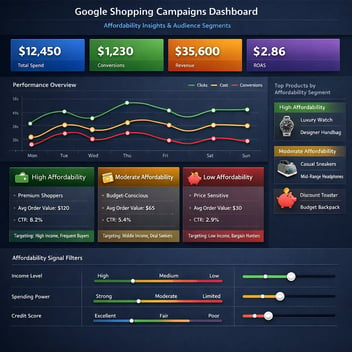
How to Reduce Ad Waste With Affordability Segmentation

Key Takeaways: Reducing Advertising Waste With Affordability-Based Audience Segmentation
- Affordability-based audience segmentation filters out consumers who lack purchasing capacity, reducing wasted impressions on audiences unlikely to convert.
- Afford-X applies modeled affordability signals to help advertisers exclude unqualified audiences before campaigns launch, improving media efficiency.
- Traditional targeting methods often miss the gap between intent and actual purchasing capacity, resulting in budget allocated toward window shoppers.
- Pre-campaign exclusion segments offer more value than post-campaign optimization by preventing wasted spend rather than correcting it after the fact.
- Combining behavioral, demographic, and affordability signals creates a more complete audience picture that drives higher conversion efficiency.
What Is Advertising Waste and Why Does It Persist?
Advertising waste occurs when media spend reaches consumers who are unlikely to convert, regardless of how interested they appear. A consumer might click an ad, browse a product page, and even add items to a cart—yet never complete a purchase. This gap between demonstrated intent and actual conversion represents a significant portion of wasted advertising budgets.
The persistence of advertising waste stems from a fundamental limitation in conventional targeting approaches. Most audience targeting methods focus on identifying relevance and intent through signals like browsing behavior, demographic characteristics, and contextual alignment. These approaches can identify who might be interested in a product or service.
However, interest alone does not predict purchasing capacity. Two consumers with identical browsing histories and demographic profiles may have vastly different abilities to complete a purchase. One may have the financial flexibility to convert immediately. The other may be researching for a future goal or simply exploring options with no realistic path to purchase.
How Traditional Audience Targeting Misses Affordability Signals
Traditional targeting frameworks rely on several data categories: demographics, behavioral signals, interests, and contextual alignment. Each category captures a piece of the audience puzzle. Demographics tell you who someone is. Behavioral signals reveal what they do online. Interest data suggests what topics engage them. Contextual targeting places ads alongside relevant content.
The core limitation is that none of these categories directly measure a consumer's ability to purchase. A 35-year-old professional browsing luxury goods content may fit the demographic and behavioral profile perfectly—yet carry debt loads or household obligations that make a purchase unrealistic in the near term.
Some advertising platforms offer household-income targeting capabilities. However, affordability extends beyond reported income alone. Actual purchasing capacity is influenced by obligations like rent or mortgage payments, existing debt, household composition, financial commitments, and broader economic factors. As a result, two consumers with similar reported incomes may have very different probabilities of converting on the same offer.
What Is Affordability-Based Audience Segmentation?
Affordability-based audience segmentation addresses this gap by incorporating modeled purchasing capacity signals into the targeting process. Rather than relying solely on intent and demographic indicators, this approach adds a layer of affordability intelligence that estimates whether a consumer is financially positioned to convert.
Afford-X is designed to address this gap by applying modeled affordability signals so advertisers can filter, refine, or prioritize audiences based on likely purchasing capacity. The affordability layer operates alongside conventional targeting inputs such as interests, demographics, behavioral signals, contextual targeting, and intent data.
The core objective is straightforward: allocate advertising budget toward consumers who are not only likely to be interested but also realistically able to purchase. This dual qualification—intent plus affordability—creates a more efficient audience that converts at higher rates.
Why Pre-Campaign Exclusion Outperforms Post-Campaign Optimization
Most optimization happens after campaigns launch. Advertisers run ads, collect performance data, identify underperforming segments, and adjust targeting. This reactive approach has value, but it accepts a baseline level of wasted spend as a cost of learning.
Pre-campaign exclusion represents a different philosophy. By filtering out low-affordability audiences before the first impression is served, advertisers prevent waste rather than correct it. Every impression reaches a consumer with demonstrated purchasing potential.
Consider the difference in campaign economics. Reactive optimization might reduce cost-per-acquisition by 15-20% over the course of a campaign as the algorithm learns. Pre-campaign exclusion can achieve similar or greater efficiency from day one by removing audiences that would never convert regardless of creative messaging or offer structure.
Afford-X enables advertisers to eliminate inefficient media spend by applying modeled affordability filters directly within platforms like Meta and Google DV360. Advertisers can continue using the audience definitions, campaign structures, and activation platforms they already rely on. The affordability layer functions as an enhancement, not a replacement.
How Affordability Signals Differ From Income-Based Targeting
Income-based targeting segments audiences by reported household income brackets. This approach provides some directional value but carries significant limitations. Reported income represents a single data point that fails to capture the complexity of actual purchasing capacity.
Affordability signals incorporate multiple factors beyond income alone. Household obligations such as mortgage or rent payments reduce available purchasing power. Debt load—including credit cards, auto loans, and student debt—constrains financial flexibility. The number of dependents in a household affects discretionary spending capacity. Regional cost-of-living differences mean that identical incomes yield different purchasing power across geographies.
Afford-X is intended to address these factors by modeling broader affordability dynamics rather than relying on income brackets alone. The result is a more nuanced audience signal that better predicts actual conversion probability. This approach helps advertisers identify audiences with the highest purchasing power potential.
The Gap Between Reported Income and Purchasing Capacity
A household earning $150,000 annually in San Francisco faces different economic realities than one earning the same amount in Austin. Housing costs alone can consume vastly different portions of household income across markets. Income-based targeting treats these households identically, missing the geographic component of affordability.
Similarly, a dual-income household with no children has different discretionary spending capacity than a single-income household of the same gross income with three dependents. Lifestyle factors, debt decisions, and financial priorities create meaningful variation within income brackets.
Affordability modeling accounts for these factors by estimating purchasing capacity rather than simply categorizing by income range. The outcome is audience segments that more accurately reflect who can realistically convert.
How to Build Affordability-Based Exclusion Segments
Building effective exclusion segments requires combining multiple data inputs into a cohesive affordability model. The process involves several key steps that translate raw data into actionable audience segments.
Step 1: Define Conversion Thresholds
Start by identifying the minimum purchase value or commitment level for your products or services. A $50 impulse purchase has different affordability requirements than a $5,000 enterprise software subscription. Your affordability threshold should align with what the product actually costs consumers.
For advertisers selling across multiple price points, create separate affordability segments for different product tiers. A consumer who cannot afford the premium offering may still convert on an entry-level option.
Step 2: Integrate Affordability Signals Into Targeting
Afford-X operates alongside conventional targeting inputs. This means you can layer affordability filters onto existing audience definitions without rebuilding your entire campaign structure. If you currently target consumers interested in home renovation, for example, you can add an affordability layer that excludes those unlikely to afford major renovation projects.
The Ad Account Integration and Audience Activation capability connects affordability data and segments directly into ad platforms and other activation tools. This automation means marketers can act on affordability intelligence in live campaigns without manual segment building.
Step 3: Exclude Low-Propensity Audiences Before Launch
The affordability layer is intended to improve audience efficiency by helping advertisers reduce impressions served to lower-propensity consumers. Apply exclusion segments during campaign setup rather than waiting for performance data to accumulate.
This pre-launch exclusion approach means your learning budget—the spend required for platforms to optimize delivery—reaches higher-quality audiences from the start. Algorithm learning happens faster when every impression serves a qualified prospect.
What Causes Affordability-Based Segmentation to Fail?
Affordability-based segmentation delivers value when implemented correctly, but several common mistakes can undermine results. Understanding these failure points helps advertisers avoid them.
Over-Exclusion Reduces Addressable Audience
Aggressive affordability thresholds can shrink your addressable audience below viable levels. If exclusion criteria remove 90% of your target market, remaining reach may be insufficient for efficient campaign delivery. Finding the right balance between efficiency and scale requires testing.
Start with moderate exclusion thresholds and measure impact on both conversion rates and delivery costs. Tighten criteria incrementally based on performance data rather than applying maximum exclusion from day one.
Affordability Signals Become Stale Without Refresh
Consumer financial situations change. A household that lacked purchasing capacity six months ago may have paid down debt, received a raise, or experienced other changes that shift their affordability profile. Static exclusion segments based on outdated data exclude current prospects.
Affordability modeling requires regular data refresh to maintain accuracy. The Afford-X Audience Segment Library offers prebuilt affordability and behavior-based audience segments that receive ongoing updates. This helps marketing and risk teams deploy consistent, proven audiences for campaigns.
Ignoring Product-Specific Affordability Requirements
A one-size-fits-all affordability segment across your entire product portfolio misses important nuances. A consumer excluded from luxury tier products may qualify perfectly for mid-market offerings. Conversely, a consumer who can afford entry-level products may not be worth targeting if your economics require higher-value conversions.
Build affordability segments that map to specific product tiers, price points, or customer value thresholds. The AI Campaign Segment Recommendation capability automatically suggests high-value, affordability-aware audience segments based on campaign objectives, helping align exclusion criteria to specific goals.
How Affordability Segmentation Fits Into Existing Workflows
Adoption of new targeting approaches often stalls due to implementation complexity. Affordability-based segmentation is designed to function as an enhancement layer within existing advertising and media buying workflows rather than as a replacement for current processes.
Advertisers can continue using the audience definitions, campaign structures, and activation platforms they already rely on. The affordability layer adds a filtering step that improves audience quality without requiring wholesale changes to campaign architecture.
In practice, this means performance marketing teams can test affordability segmentation on existing campaigns with minimal setup changes. Apply exclusion segments to current audience definitions, run performance comparisons against control groups, and measure incremental lift in conversion efficiency.
Integration With Programmatic Buying
Programmatic advertising operates on real-time bidding decisions across millions of impression opportunities. Affordability signals can inform bid adjustments or exclusion rules within programmatic platforms, ensuring that automated buying decisions account for purchasing capacity.
For advertisers using demand-side platforms, affordability data can be incorporated as a targeting parameter alongside existing audience criteria. This integration allows the buying algorithm to factor affordability into impression valuation and bid calculations.
Integration With CRM-Based Targeting
Customer relationship management data often powers custom audiences and lookalike modeling. By enriching CRM records with affordability indicators, advertisers can build lookalike audiences that match not just behavioral and demographic profiles but also purchasing capacity profiles.
The Affordability Data Modeling and Analytics Service helps organizations derive actionable scores, segments, and insights from their financial and behavioral data. This professional services offering supports custom affordability models tailored to specific business contexts.
What Results Can Advertisers Expect From Affordability Segmentation?
The intended outcome is cleaner audience targeting, improved media efficiency, and reduced wasted advertising spend. By filtering out consumers who cannot realistically convert, advertisers may improve conversion quality, increase campaign efficiency, and strengthen return on advertising spend.
The result is fewer wasted impressions, higher conversion efficiency, and more disciplined allocation of budget toward audiences with true purchasing power. These improvements compound over time as cleaner audiences generate better performance data for platform optimization.
Impact on Cost-Per-Acquisition
When exclusion segments remove low-propensity consumers from the targeting pool, cost-per-acquisition typically decreases. Fewer impressions are wasted on audiences that would never convert, meaning the same budget generates more conversions.
The magnitude of improvement depends on baseline targeting quality. Advertisers with broadly targeted campaigns often see more dramatic improvements than those already using sophisticated segmentation. However, even well-targeted campaigns typically contain some percentage of low-affordability audiences that exclusion segments can filter.
Impact on Conversion Rate
Conversion rate increases when a higher percentage of reached consumers have both the intent and the ability to purchase. Affordability segmentation contributes to this by removing the cohort of interested-but-unable consumers who inflate reach metrics without contributing to conversions.
Higher conversion rates also improve platform algorithm performance. Advertising platforms optimize toward conversions, and cleaner conversion signals help algorithms identify and reach high-value prospects more efficiently.
How to Measure Affordability Segmentation Performance
Measuring the impact of affordability segmentation requires isolating its contribution from other campaign variables. Several approaches help advertisers quantify value.
Control-Treatment Testing
Run parallel campaigns with identical creative, bidding, and budget parameters. Apply affordability exclusion segments to the treatment group while leaving the control group unchanged. Compare conversion rates, cost-per-acquisition, and return on ad spend between groups.
This controlled approach isolates the impact of affordability segmentation from other variables. Run tests for sufficient duration to reach statistical significance before drawing conclusions.
Incrementality Measurement
Beyond direct conversion metrics, measure whether affordability segmentation drives incremental conversions or simply reallocates existing ones. Geo-based holdout testing or platform-provided incrementality tools can help quantify true lift from the affordability layer.
Long-Term Customer Value Analysis
Customers acquired through affordability-filtered campaigns may differ in lifetime value from those acquired through broader targeting. Track cohort performance over time to understand whether affordability segmentation improves not just conversion efficiency but also customer quality and retention.
FAQs About Reducing Advertising Waste With Affordability-Based Audience Segmentation
What is affordability-based audience segmentation?
Affordability-based audience segmentation filters advertising audiences by purchasing capacity rather than just intent or demographics. Afford-X applies modeled affordability signals so advertisers can exclude consumers unlikely to convert based on financial factors, improving campaign efficiency.
How does affordability segmentation differ from income targeting?
Income targeting uses reported household income brackets, while affordability segmentation incorporates multiple factors: debt load, household obligations, regional costs, and financial flexibility. Afford-X models broader affordability dynamics to estimate actual purchasing capacity rather than relying on income alone.
Can affordability segmentation work with existing ad platforms?
Affordability segmentation is designed to function as an enhancement layer within existing workflows. Afford-X integrates with platforms like Meta and Google DV360, allowing advertisers to apply affordability filters while continuing to use their current audience definitions and campaign structures.
What causes advertising waste in audience targeting?
Advertising waste occurs when ads reach consumers who are interested but unable to purchase. Traditional targeting identifies intent through behavior and demographics but misses purchasing capacity. This gap between interest and affordability results in impressions served to audiences that cannot realistically convert.
How much can affordability segmentation reduce wasted ad spend?
Results vary based on baseline targeting quality and product price points. Afford-X is designed to filter out non-converting audiences before campaigns launch, with the intended outcome of cleaner targeting and reduced wasted impressions. Advertisers may improve conversion quality and strengthen return on advertising spend.
Is affordability segmentation suitable for all industries?
Affordability segmentation offers the most value for products and services with meaningful purchase thresholds—typically mid-market to premium offerings where purchasing capacity varies significantly across the target audience. Lower-priced impulse purchases may see less impact from affordability filtering.
How often should affordability segments be refreshed?
Consumer financial situations change over time, making regular segment refresh important. Afford-X's Audience Segment Library offers prebuilt segments that receive ongoing updates. For custom segments, quarterly review and refresh helps maintain accuracy as economic conditions and individual circumstances evolve.