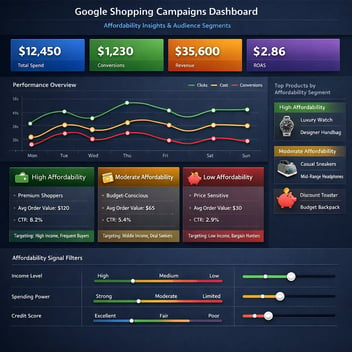
Why Affordability Analytics Breaks in Paid Growth

Performance marketing teams have gotten very good at optimizing for intent. They have not gotten good at optimizing for affordability — and that gap is quietly inflating CPA across nearly every paid channel.
Affordability analytics is the practice of measuring not just who is likely to click or convert, but who can actually afford to buy. It sits downstream of attribution modeling and upstream of budget allocation, which is exactly why it breaks so easily: a distortion introduced early in the funnel compounds by the time it reaches your ROI dashboard.
Below are the five places affordability analytics most commonly fails in performance marketing, and what to fix first.
1. Intent Signals Get Treated as Purchasing Power
Most campaign optimization stacks are built on behavioral and search intent — page views, add-to-carts, lookalike audiences built from past converters. Intent signals answer "is this person interested?" They say nothing about "can this person pay?"
Those two questions get conflated constantly. A user who repeatedly browses a $3,500/month enterprise tool isn't necessarily a buyer — they may be a student, a competitor, or simply curious. When affordability isn't modeled as a separate variable from intent, campaign optimization algorithms learn to chase engagement, not revenue-qualified demand. CPA creeps up because the algorithm is technically working — it's just optimizing for the wrong thing.
Fix first: Separate your intent signal from your affordability signal before they ever reach the bidding layer. Treat them as two independent scores, not one blended one.
2. Attribution Models Assume Every Conversion Is Equal
Attribution modeling — first-touch, last-touch, linear, data-driven — allocates credit across the funnel, but almost none of it accounts for whether the converting customer could sustain the purchase. A $50 CAC lead that churns after one billing cycle because the price point was never realistic gets counted identically to a $50 CAC lead who stays for two years.
This is where affordability analytics breaks quietly: the marketing ROI math looks healthy at the point of conversion and only reveals itself as broken three to six months later, once churn and refund data roll in. By then, the budget that produced the low-affordability conversions has already been reallocated toward "what's working."
Fix first: Weight attribution credit by downstream retention or payment completion, not just conversion event. A conversion that doesn't survive contact with a billing cycle shouldn't get full attribution credit.
3. Lookalike and Retargeting Audiences Inherit the Bias
Once a campaign converts a batch of low-affordability users, most platforms' lookalike modeling does exactly what it's designed to do: it finds more people who resemble those converters. If the seed audience skewed toward people who converted but couldn't sustain the purchase, the lookalike expansion scales that mismatch, not fixes it.
This is one of the most common — and least visible — reasons cost per acquisition rises over time even when creative and targeting stay constant. The audience itself is drifting toward unaffordability with every optimization cycle.
Fix first: Audit your seed audiences for affordability composition before expanding into lookalikes. A technically high-converting seed audience can still be the wrong seed audience.
4. Exclusion Logic Is an Afterthought, Not a Filter
Most performance marketing stacks are built to expand reach, not narrow it. Exclusion lists typically cover existing customers or obvious disqualifiers (wrong geography, wrong device), but rarely filter for affordability at the point of ad delivery. That means budget is actively spent competing for impressions against unconvertible demand — a cost that never shows up as a line item, but shows up in a rising CPA anyway.
Fix first: Build an affordability exclusion filter that runs before the bid, not after the conversion. Removing unconvertible intent from the auction is cheaper than acquiring and then losing that customer.
5. ROI Reporting Hides the Real Cost of Misallocation
Marketing ROI reporting typically aggregates at the campaign or channel level, which is exactly the resolution that hides affordability failures. A channel can show positive ROI in aggregate while a meaningful share of its "wins" are unprofitable once affordability is accounted for — the profitable segment is simply subsidizing the unprofitable one in the topline number.
Fix first: Break ROI reporting out by affordability tier, not just channel or campaign. If the profitable segment and the unprofitable segment are reported together, you can't fix what you can't see.
The Common Thread
Every one of these failure points traces back to the same root cause: affordability is treated as a downstream reporting concern instead of an upstream targeting input. By the time a team notices CPA drifting up or ROI softening, the actual cause — audiences skewing toward people who can't sustain a purchase — is already baked into the attribution model, the lookalike seeds, and the bidding algorithm itself.
Fixing this doesn't require abandoning intent-based targeting. It requires treating affordability as its own signal, filtered in before the auction rather than diagnosed after the invoice.
Afford-X builds affordability intelligence for performance marketing teams — filtering unconvertible intent out of paid audiences before budget is spent, not after.