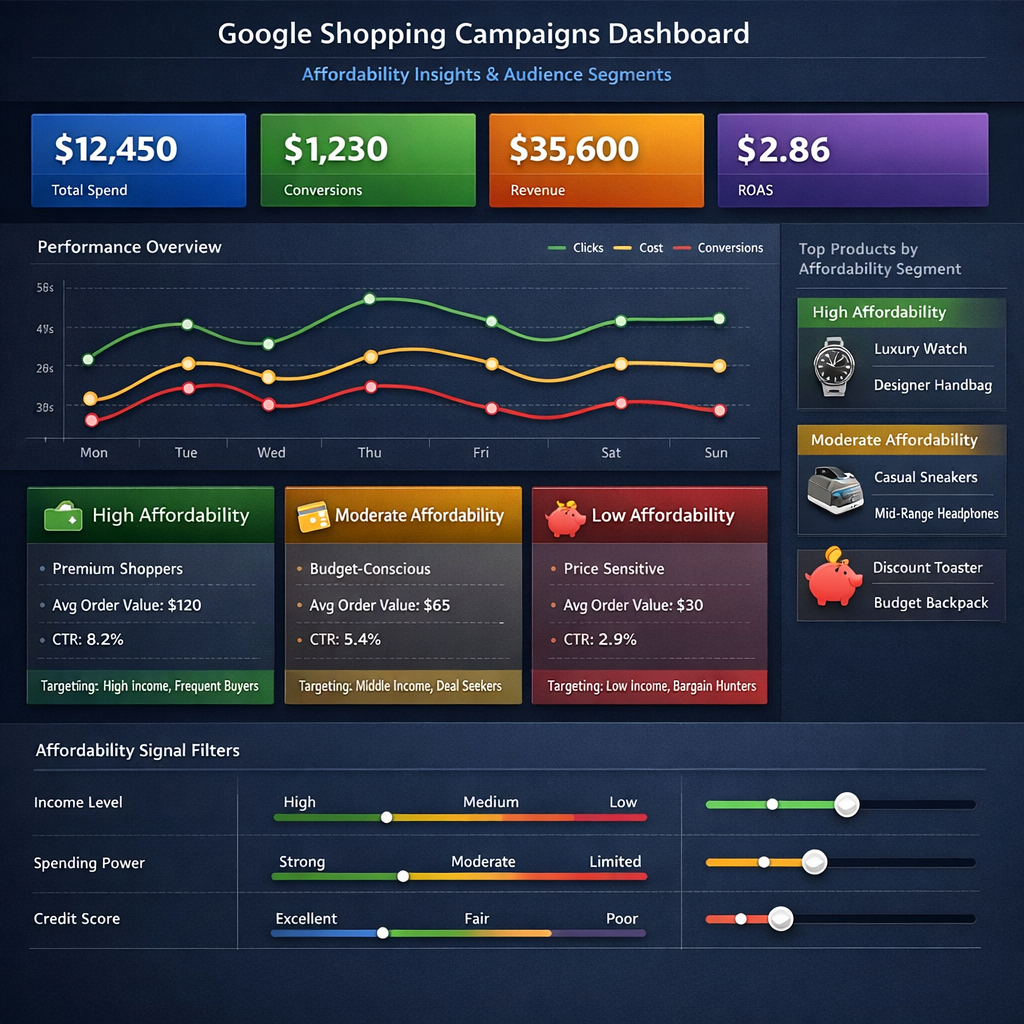
Affordability exclusion segments apply modeled purchasing capacity signals to Google Shopping campaigns, filtering audiences based on financial readiness to convert rather than intent alone.
Why Intent-Based Targeting Alone Leaves Conversion Gaps in Shopping Campaigns
Google Shopping campaigns typically rely on product-level signals, search query relevance, and behavioral intent patterns to determine impression delivery. While those targeting mechanisms effectively identify consumer interest and product consideration, they frequently include audiences with insufficient purchasing capacity to complete transactions. The result is media spend allocated to impressions that generate clicks but do not convert, creating inefficiency in campaign performance and return on advertising spend.
Most Shopping campaign audiences are constructed using search intent, product feed attributes, demographic overlays, and remarketing lists. These inputs establish relevance but do not filter for financial readiness. Two consumers searching for the same high-consideration product may exhibit identical browsing behaviors and engagement patterns while possessing dramatically different purchasing capacity based on disposable income, household financial obligations, and debt load. As a result, campaigns optimized for intent signals alone often serve impressions to audiences unlikely to convert regardless of creative quality or offer strength.
The operational challenge for agencies and performance marketing teams is that standard Shopping campaign structures lack native affordability filtering mechanisms. Platform-provided income targeting capabilities address gross household income but do not account for the multi-factor dynamics that determine actual purchasing capacity. Advertisers managing Shopping campaigns across multiple product categories and price points require a more granular approach to audience qualification that operates within existing campaign architectures rather than replacing established workflows.
How Affordability Signals Filter Shopping Audiences by Purchasing Capacity
Affordability exclusion segments apply modeled purchasing capacity signals to Shopping campaign audiences, removing consumers who demonstrate intent but lack financial readiness to convert. These segments are constructed using proprietary models that analyze disposable income patterns, household financial obligations, credit utilization trends, and economic commitment indicators rather than relying on reported income alone. The intended outcome is audience pools filtered for both product interest and transaction likelihood, reducing wasted impressions on high-intent but financially constrained consumers.
The modeling approach evaluates purchasing capacity across multiple financial dimensions that influence conversion probability. Actual purchasing capacity is influenced by disposable income after fixed obligations, discretionary spending patterns, debt service ratios, savings behavior, and recent financial stress indicators. The affordability layer processes these inputs to generate exclusion segments that identify consumers unlikely to complete purchases within specific price ranges, even when search behavior and engagement metrics suggest strong product interest.
In practice, affordability exclusion segments operate alongside conventional Shopping campaign targeting inputs such as product feed attributes, search query matching, audience lists, and demographic overlays. Advertisers can continue using the campaign structures, bidding strategies, and optimization approaches they already rely on while applying affordability filters to refine impression delivery. The exclusion mechanism functions at the audience level rather than modifying product feeds or campaign architecture, preserving existing workflows while improving audience efficiency through financial readiness filtering.
Integration Architecture for Affordability Exclusion in Google Shopping
Affordability exclusion segments integrate with Google Shopping campaigns through audience exclusion list application within existing campaign structures. The segments are delivered as audience lists compatible with Google Ads audience management interfaces, allowing media directors and programmatic advertising managers to apply exclusions at the campaign or ad group level without modifying product feeds, campaign types, or bidding configurations. This architecture is designed to function as an enhancement layer within established Shopping workflows rather than requiring platform migration or campaign rebuilds.
The operational integration sequence begins with segment delivery through Google Ads API connections or direct audience list provisioning. Affordability exclusion segments are structured as custom audience lists that populate within the shared library of the target Google Ads account. Once provisioned, these segments become available for application across Standard Shopping, Performance Max for retail, and Smart Shopping campaign types through the audience exclusion controls native to each campaign format. The segment application process mirrors standard audience exclusion workflows, requiring no specialized technical implementation beyond initial account connection.
For agencies managing multiple client accounts or enterprise teams operating Shopping campaigns across business units, affordability exclusion segments can be deployed through manager account structures or automated via Google Ads scripts and API integrations. The segment refresh cadence typically operates on a weekly or bi-weekly basis to maintain signal accuracy as consumer financial conditions evolve. Advertisers retain full control over exclusion application decisions, segment scope definition, and price-range thresholds, allowing customization based on product margin profiles, conversion value targets, and media efficiency objectives specific to each Shopping campaign structure.
Measuring Media Efficiency Gains Through Affordability-Filtered Product Feeds
Media efficiency measurement for affordability-filtered Shopping campaigns focuses on cost-per-acquisition reduction, conversion rate improvement, and impression waste elimination rather than top-of-funnel metrics alone. The primary performance indicators include CPA variance between filtered and unfiltered campaign segments, conversion rate lift among audiences not excluded by affordability signals, and impression volume reduction in audience segments with low historical conversion probability. These metrics provide direct quantification of budget allocation improvement achieved through purchasing capacity filtering.
Campaign performance analysis typically compares cohorts exposed to affordability exclusions against control groups receiving standard Shopping campaign targeting without financial readiness filters. The measurement framework isolates the incremental impact of exclusion segments by evaluating conversion efficiency changes while controlling for product selection, creative variables, bidding strategy modifications, and seasonal demand fluctuations. Media directors and analytics leads monitoring these comparisons frequently observe conversion rate improvements of 15-30 percent and CPA reductions of 20-40 percent in product categories with high price sensitivity and significant variance in consumer purchasing capacity.
Operational reporting for affordability-filtered Shopping campaigns extends standard Google Ads performance dashboards with excluded impression volume tracking, segment overlap analysis, and purchasing capacity distribution insights. These reports identify which product categories, price ranges, and audience segments demonstrate the highest sensitivity to affordability filtering, informing ongoing optimization decisions and exclusion threshold adjustments. For agencies managing Shopping campaigns across multiple retail verticals, this measurement approach enables portfolio-level media efficiency evaluation and client-specific segment calibration based on product margin structures and conversion value targets.
Operational Workflow for Applying Exclusion Segments to Shopping Campaign Structures
The operational workflow for implementing affordability exclusion segments in Google Shopping campaigns begins with segment provisioning and account connection establishment. Agencies and enterprise marketing teams initiate integration by connecting target Google Ads accounts through OAuth authentication or manager account delegation. Once account access is configured, affordability exclusion segments are delivered as audience lists within the shared library, organized by price range thresholds, product category alignment, and purchasing capacity filter intensity. This initial setup typically requires 3-5 business days for segment generation and audience list population.
Following segment provisioning, media directors and performance marketing managers apply exclusion lists to relevant Shopping campaign structures through the audience exclusion interface within campaign settings. The application decision process involves evaluating product price points, target ROAS thresholds, and historical conversion data to determine appropriate exclusion segment intensity. High-value product campaigns with narrow profit margins typically receive more aggressive affordability filtering, while lower-price-point or high-volume campaigns may apply exclusions selectively to preserve impression scale. Campaign-level exclusion application allows granular control over segment usage across different product categories and business objectives within a single Google Ads account.
Ongoing operational management includes segment performance monitoring, exclusion threshold adjustment, and periodic segment refresh coordination. Performance marketing teams review conversion efficiency metrics weekly or bi-weekly to assess exclusion segment impact and identify optimization opportunities. Segment refresh occurs automatically on a scheduled cadence to maintain signal accuracy as consumer financial conditions evolve, requiring no manual intervention once initial workflows are established. For agencies managing Shopping campaigns across multiple client accounts, this workflow scales through manager account structures and automated reporting dashboards that track affordability exclusion performance across client portfolios.