Market report: US Digital ad targetting.
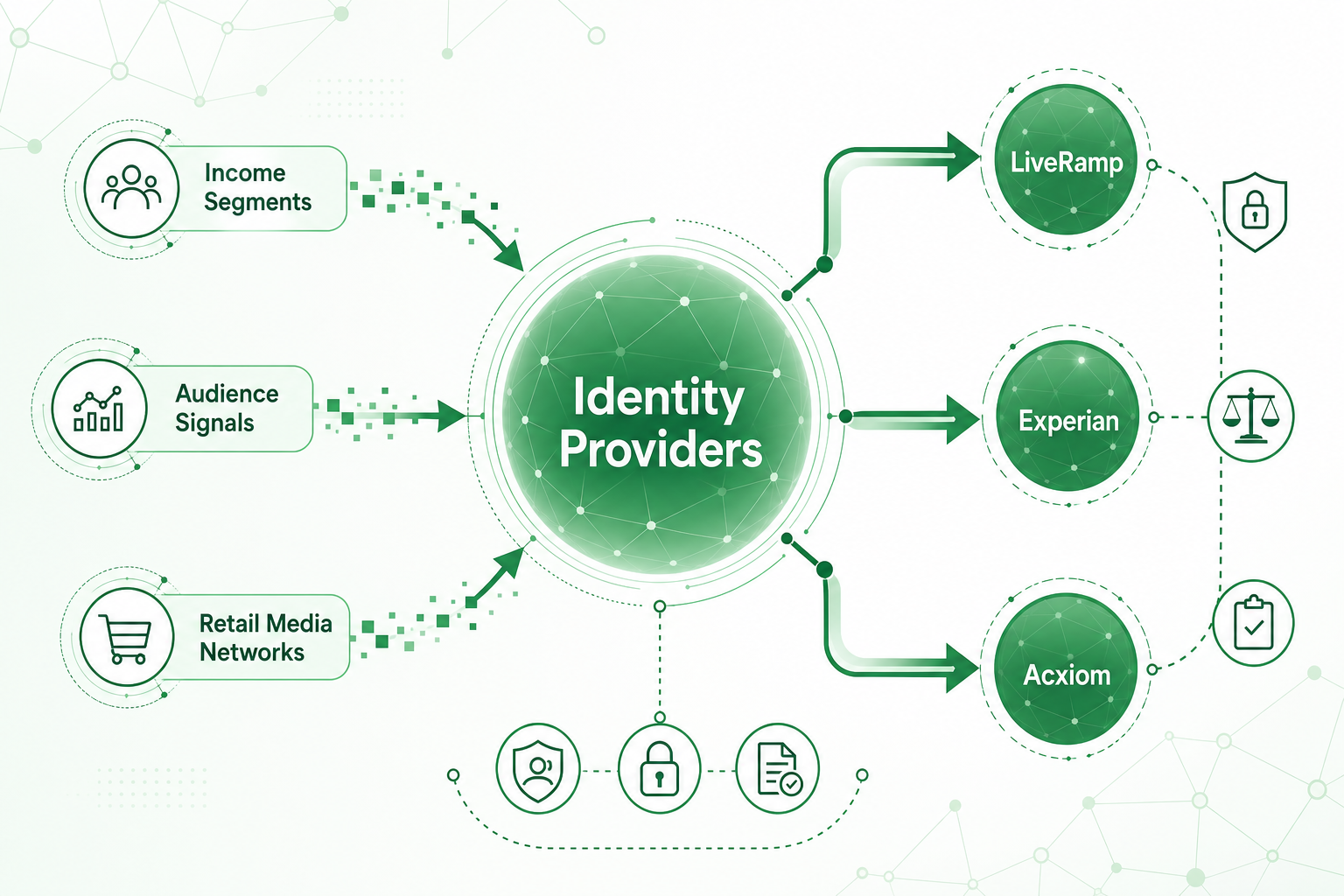
- The audience-data market has consolidated sharply: Oracle exited advertising entirely (end-of-life September 30, 2024) and Google formally killed Privacy Sandbox (October 2025), leaving LiveRamp, Experian, Epsilon, Acxiom, TransUnion, and retail media networks as the dominant players — while the big ad platforms (Meta, Google) pivot from manual segment targeting toward AI-driven, signal-fed automation.
- Third-party audience segments — including income and "affordability" segments — are frequently inaccurate: independent studies (Neumann/Tucker, Truthset, Deloitte) find gender segments barely beat a coin flip and 51–60% of targeting data can be wrong; income/net-worth segments are almost always modeled ZIP+4 proxies, not verified data, and one audit found a single person listed in five income brackets simultaneously.
- Regulation is a patchwork that, ironically, protects income targeting: 20 state privacy laws are in effect in 2026 and the FTC is aggressively pursuing location-data brokers, but the federal CFPB rule that would have pulled income/financial marketing segments under the FCRA was withdrawn (May 15, 2025), so income-based ad targeting remains largely unregulated at the federal level.
Key Findings
1. The provider landscape has consolidated around identity, not just data
The classic ad-targeting supply chain still runs: a data company (Acxiom, Experian, Comscore, TransUnion) builds segments → an onboarder/identity layer (LiveRamp) resolves them to digital IDs → a DSP (The Trade Desk, Amazon DSP, Google DV360) activates them → results are measured. Two 2024–2025 shocks reshaped it:
- Oracle exited advertising. Oracle announced in June 2024 it was shutting its ad business (Oracle Data Cloud / Oracle Advertising), with end-of-life on September 30, 2024. This eliminated BlueKai (DMP), Datalogix (offline purchase data), Grapeshot (contextual), and Moat (measurement) — assets built through billions in acquisitions ($1.2B for Datalogix, $850M for Moat, plus BlueKai, Grapeshot, and others). Revenue had collapsed from ~$2B (FY2022) to ~$300M (FY2024). AdExchanger called the speed of the shutdown "unheard of."
- Google killed Privacy Sandbox. After reversing third-party-cookie deprecation in July 2024 and dropping the standalone cookie prompt in April 2025, Google retired the remaining Privacy Sandbox APIs (Topics, Protected Audience, Attribution Reporting) in October 2025, confirming to Adweek the initiative was over ("moving away from the Privacy Sandbox branding"). Third-party cookies remain enabled in Chrome by default — an outcome that favors first-party-data holders and identity vendors and leaves measurement fragmented rather than replaced by a single new standard.
Major providers and what they offer today:
- LiveRamp — the dominant identity/onboarding layer (RampID), data collaboration, clean rooms, and a Data Marketplace. Split from Acxiom in 2018; positioned as neutral connective tissue across walled gardens and retail media networks. Acquired clean-room vendor Habu to deepen collaboration capability. Best suited to brands with mature first-party data infrastructure.
- Experian — consumer marketing data (ConsumerView, ~300M individuals / 126M households, 5,000+ demographic and behavioral attributes), Mosaic geodemographic segmentation (classifying US households into ~71 types / 19 groups), plus a legally separate FCRA-regulated credit side (Income Insight). Ranked #1 for accuracy by Truthset's Data Collective.
- Epsilon (Publicis) — CORE ID deterministic identity, TotalSource Plus database (~125M households), transaction-rooted segments (Abacus co-op and former Equifax Marketing Services heritage), and a tight media-activation loop via the former Conversant platform.
- Acxiom (now under Omnicom following the IPG merger) — deterministic identity (Real Identity), Personicx segmentation, InfoBase attributes; strong offline/CRM depth and deterministic matching at scale.
- TransUnion — TruAudience marketing suite (AdAdvisor, ElementOne), built on a marketing identity graph kept explicitly separate from its regulated credit data; absorbed Neustar (acquired 2021).
- Eyeota (Dun & Bradstreet), Comscore, and others — off-the-shelf third-party segment marketplaces spanning demographic, interest, intent, purchase-based, and seasonal signals.
- Retail media networks are the fastest-growing category. US advertisers will spend $69.33B on retail media in 2026, up from $58.79B in 2025, with Amazon Ads and Walmart Connect capturing $9.42B of the $10.53B incremental spend (89%), per EMARKETER's "Retail Media Ad Spending Forecast and Trends H2 2025." Amazon Ads held 79.7% US retail-media share in 2025 and is forecast at $56.71B in 2026 US retail-media ad spend (EMARKETER, Dec 2025). Walmart Connect, Kroger Precision Marketing, Target Roundel, and Instacart round out the leaders; DoorDash and Instacart each generate close to $1 billion in annual US ad revenues (EMARKETER, Dec 2025). Their edge is unmatched: first-party purchase data plus closed-loop measurement (the retailer sees whether the ad drove the sale).
How segments are built: behavioral (browsing/clickstream via cookies/MAIDs), demographic (age, gender, income — often modeled from census/ZIP), purchase-based (offline transaction/loyalty data, strongest in retail media), and intent (in-market signals, B2B research behavior via co-ops such as Bombora's 200+ publisher network). Deterministic matching (verified PII) is materially more accurate than probabilistic modeling (inferred).
2. Platforms are moving from segment targeting to AI signal-feeding
- Meta has systematically deprecated manual targeting. As of June 23, 2025 it consolidated many detailed-interest categories (merging specifics like "EDM fans" and "vegan food" into broad groups) and removed detailed-targeting exclusions entirely; pre-existing campaigns using discontinued interests stopped delivering January 15, 2026. Advantage+ (powered by the "Andromeda" retrieval engine, which processes 10,000+ signals per impression) now treats advertiser inputs as suggestions, not hard rules, for most objectives — only location and minimum age remain true constraints. Per Tinuiti's Q2 2025 Digital Ads Benchmark Report (cited by eMarketer), 35% of US retail advertiser spending on Meta went to Advantage+ shopping campaigns in Q2 2025, up from 19% two years earlier.
- Google pushes Performance Max and AI Max, which de-emphasize keyword/segment targeting in favor of "audience signals" used as hints. Household-income targeting remains available as a core detailed demographic (7 tiers), historically derived from ZIP/census data.
- The Trade Desk anchors on UID2 (a hashed-and-salted email/phone identifier), plus RampID and its Identity Alliance graph, its data marketplace, and clean-room/CRM onboarding. In its own case study it reported UID2-based display CTR 2.9× higher and CPA 2.4× better ($1.60 vs. $5.37) than non-UID2 ads.
- The through-line: first-party data (CRM, loyalty, site/app events) is now the strategic asset; third-party segments are increasingly a supplement or a seed for lookalike modeling rather than the primary targeting mechanism. AI systems reward signal density, so fragmented manual segments are being displaced by consolidated, data-fed automation.
3. Affordability / purchasing-power data: the weakest, least-regulated dimension
This is the crux. Income and spending-power segments exist and are heavily marketed, but they are almost always modeled proxies, not verified income:
- Equifax offers the most explicit affordability suite: Income360 (estimated total household income; the digital version is built at "aggregated ZIP+4 level" across up to 11 tiers to $250K+, while the offline "Complete" version reaches ~$2.0M and uses "direct-measured assets"); Spending Power (a "modeled dollar amount of what a household likely has available to spend, save, or invest," up to $1.2M/household); Affluence Index (capacity to spend/save/invest, "does not contain protected-class demographics"); Economic Cohorts (71 clusters using modeled income + "Discretionary Spending Dollars"); and Spending Insights (ZIP+4 aggregated transaction data, explicitly "not FCRA regulated"). Equifax's own product documentation (©2025) labels these "for non-FCRA applications," PII-free, and "built using anonymous, aggregated, neighborhood level data." Notably, Equifax criticizes competitors' income data as "derived from self-reported survey data or averaged over a large set of households."
- Experian offers modeled estimated household income within ConsumerView (marketing/non-FCRA) and Mosaic — distinct from its FCRA-regulated Income Insight, which estimates income from a consumer's credit data for "ability to pay" and "complies with Fair Credit Reporting Act and Equal Credit Opportunity Act regulations." In Tailford v. Experian (2020), a court affirmed the "clear divide" between Experian's non-FCRA marketing data (household income, purchase history) and its regulated credit products.
- Acxiom markets Personicx Financial, explicitly a "Regulation B friendly" system built from financial behaviors "regardless of demographic characteristics" to avoid ECOA/protected-class issues.
- TransUnion includes household income in AdAdvisor, sourced from "a combination of public and private sources, self-reported data, and modeled data," on an identity graph "separate from TransUnion's credit data."
The accuracy problem is severe and well-documented:
- An El Toro audit (published December 2023) of Oracle/InfoGroup data found one person (the company's CEO) listed in 5 different income brackets (under $35K to $499K) and a net worth spanning $0 to $27MM+ across 4 categories simultaneously; PlaceIQ listed him in every income group and as both male and female. Segment sizes were often physically impossible (e.g., a data provider claiming 365M US consumers interested in buying a Ferrari, which sells ~5,000 vehicles/year in the US).
- The peer-reviewed Neumann/Tucker/Whitfield study (Marketing Science, 2019; 19 data brokers, 90+ validated audiences) found gender accuracy averaged 42.3% — worse than the ~50% base rate — and that ads reached the intended demographic only ~59% of the time; the authors concluded third-party audiences are "often economically unattractive" except on higher-priced media.
- Truthset finds consumer data contains up to 60% error, and audiences lose ~40% additional accuracy after onboarding (a 55%-accurate segment drops to ~33%).
- Deloitte's "Predictably Inaccurate" found broker-reported income was often substantially underestimated or outdated (in one case, listing a person's annual expenses as $458).
The structural reason: most income segments are inferred from geography (ZIP/census), browsing behavior, or averaged household models — not from actual income verification, which is locked inside FCRA-regulated credit files that cannot legally be used for ad targeting. Even the platforms admit it: Google Ads income "targeting" historically mapped ZIP codes to census-derived income buckets, and Meta high-net-worth targeting is effectively top-percentile ZIP-code + luxury-interest proxying, not verified wealth.
4. How marketers evaluate providers
Consistent criteria across trade guidance:
- Match rate tested on YOUR data (not vendor claims — lab rates run 20–40% above production). Typical ranges: Meta 50–80% (email+phone), Google Ads 40–70% (multi-key), programmatic 30–60% depending on ID type.
- Data freshness / refresh cadence — contact data decays ~20–30%/year; annual or quarterly refresh is a red flag for most use cases.
- Accuracy vs. coverage tradeoff — implausibly high headline match rates can signal loose guessing rather than quality.
- Privacy/compliance posture — data-broker registration (California, Vermont, Oregon, Texas), lawful basis for processing, opt-out handling, and California Delete Act/DROP readiness.
- Transparency of methodology — a good provider can explain how each segment is built and what signals feed it.
- Pricing models — third-party data fees are typically CPM surcharges layered on media cost; run a paid 60–90 day pilot with defined match-rate and lift thresholds before committing.
- Independent validation via Truthset's Data Collective (22+ participating providers) has become a de facto accuracy currency. A landmark CIMM / Go Addressable / Truthset study (released November 5, 2025, benchmarking ~1 billion IP records from six providers) found IP-to-postal linkages accurate only ~13% of the time and IP-to-email linkages ~16% of the time, with providers agreeing on IP-to-postal links just 6.4% of the time — a major warning for CTV targeting, which leans heavily on IP. An earlier CIMM/Truthset study found hashed-email-to-household match rates as low as 32%.
5. Regulatory landscape
- 20 state comprehensive privacy laws are in effect in 2026 (Indiana, Kentucky, and Rhode Island took effect January 1, 2026; Connecticut, Arkansas, Oregon, Texas, Utah, and Virginia amendments follow mid-year). Most require opt-in consent for "sensitive data" and require honoring universal opt-out signals (Global Privacy Control). California's Delete Act DROP platform requires data brokers to process centralized deletion requests beginning August 1, 2026. Connecticut's July 1, 2026 amendments expand "sensitive data" to include additional financial and government-ID details.
- FTC enforcement has centered on location data: a finalized order against Mobilewalla (January 2025 — the first-ever ban on collecting consumer data from real-time-bidding auctions for purposes other than participating in them), plus actions against Gravy Analytics/Venntel, X-Mode/Outlogic, and ongoing Kochava litigation. In February 2026 the FTC warned 13 data brokers of their obligations under PADFAA (the Protecting Americans' Data from Foreign Adversaries Act, with penalties up to ~$53,088 per violation).
- The key gap for affordability targeting: the CFPB's December 2024 proposed rule ("Protecting Americans from Harmful Data Broker Practices," Regulation V) would have treated the sale of income-tier, credit-history, and debt-payment data as FCRA "consumer reports" even for advertising uses — but the CFPB withdrew it on May 15, 2025, citing statutory-authority concerns and misalignment with its revised FCRA interpretation. As a result, income/financial marketing segments remain outside federal FCRA regulation. The governing line is use-based: financial data becomes a regulated "consumer report" when used (or "expected to be used") as a factor in eligibility decisions (credit, insurance, employment, housing) — not when used for ad targeting. This is precisely why providers strip PII, aggregate to ZIP+4/neighborhood level, and label everything "non-FCRA."
6. Recent industry commentary (2025–2026)
Trade coverage (AdExchanger, Digiday, Adweek, MarTech, eMarketer) converges on a consistent narrative: cookie persistence plus the Sandbox's death has produced fragmentation, not a clean successor; first-party data and clean rooms are the strategic center of gravity; retail media is absorbing budget faster than analysts forecast; and AI-driven platform automation is displacing manual audience segments. AdExchanger (April 2026) framed first-party data as "structurally necessary" for the emerging agentic-AI advertising era, which requires "deterministic identity, clean feedback loops and governable data lineage."
Details / Interpretation
The central irony for a blog on affordability targeting: the ad-tech industry sells thousands of income and "purchasing power" segments, but the accurate income data (verified via credit files) is legally walled off from advertising by the FCRA. So what actually gets sold for targeting is modeled inference of highly variable quality. The providers' near-uniform defensive framing — "aggregated to ZIP+4, PII-free, non-FCRA, no protected-class variables" — is itself the tell: it's engineered to stay on the marketing side of the FCRA line, which by definition means the data is less precise than credit-grade income data. Affordability is therefore the dimension where the gap between what's marketed and what's deliverable is widest.
A second structural theme: consolidation has concentrated power in a handful of identity/first-party gatekeepers (LiveRamp, the retail media networks, the walled gardens). As Oracle's collapse showed, a pure third-party-data business without a durable identity spine or first-party relationship is increasingly untenable. The winners are those who own the customer relationship (retailers, platforms) or the identity resolution layer that stitches everyone else together.
Recommendations
- Treat third-party income/affordability segments as directional, not precise. Use them for broad tiering (e.g., top vs. bottom quintile) and expect roughly 50–70% accuracy at best on income; layer them, never rely on a single segment. Threshold that would change this: if a Truthset-validated income segment scores below AA, don't pay premium CPMs for it.
- Prioritize first-party and retail-media purchase data for any affordability-sensitive campaign. Actual purchase history is the only reliable proxy for what someone can and will spend — it beats modeled income decisively. If you lack scale, pursue clean-room collaboration (LiveRamp/Habu, Snowflake, Amazon/Walmart clean rooms).
- Run a live match-rate and accuracy bake-off on your own ideal-customer list across 2–3 providers before signing; measure match rate, accuracy, and field-level coverage separately, and require data-broker registration plus written non-FCRA use certification.
- Design for the AI-automation shift. On Meta and Google, feed clean first-party conversion signals (server-side via Conversions API / enhanced conversions) and diverse creative rather than over-constraining with manual segments — creative is increasingly the de facto targeting lever.
- Monitor the regulatory triggers. If the CFPB re-proposes an FCRA data-broker rule, or if more states classify financial data as "sensitive" (as Connecticut did effective July 1, 2026), the economics of income-based targeting could shift quickly. Build consent/opt-out infrastructure (GPC recognition, DROP handling) now rather than reactively.
Caveats
- Ownership is in flux. The Omnicom–IPG merger affects Acxiom's and (indirectly) the broader agency-data landscape; confirm current corporate parents and product branding before publishing.
- Many accuracy statistics come from interested parties. Truthset sells validation; Experian cites its own #1 Truthset ranking; TransUnion's ROAS figures are marketing claims. Attribute these; do not present them as neutral. The strongest independent accuracy evidence is the academic Neumann/Tucker study and the El Toro and Deloitte audits.
- "Income360" is an Equifax product, not Experian — a common point of confusion. Experian's marketing income tool is ConsumerView estimated income/Mosaic; its FCRA income tool is Income Insight.
- Source quality varies. Several market-overview figures come from vendor/SEO blogs; the load-bearing facts (Oracle's exit, Sandbox shutdown, CFPB withdrawal, FTC actions, the Neumann/Tucker study, state-law effective dates, eMarketer retail-media forecasts) are corroborated by primary or reputable sources (FTC.gov, Federal Register, Adweek, AdExchanger, eMarketer, Marketing Science, provider documentation).
- The space moves fast. All platform-feature specifics are current to roughly mid-2026 and should be spot-checked against provider docs at publication time.